Written by
Chamitha Lokuwithana — Ex-VicRoads Licence Testing Officer
1,800+ official drive tests conducted · Founder, Lessons2Drive
Flashing your headlights feels like a natural part of road communication — warning someone about a hazard, signalling a thank you, or letting a driver merge ahead of you. In Victoria, some of these uses are legal and some are not. And there is one headlight rule that applies specifically to the VicRoads drive test that most learners don't know about until it ends their test. This guide covers every headlight scenario clearly — what's legal, what's not, and what the drive test criteria require.
The Law — Regulation 218, Road Safety Road Rules 2017
What Regulation 218 Actually Says
A driver must not use high beam headlights unless the vehicle is on a road that is not lit by street lights, or the vehicle is at least 200 metres from an oncoming vehicle or a vehicle the driver is following.
The regulation also prohibits using any light fitted to a vehicle in a way that dazzles or is likely to dazzle another road user — which covers scenarios beyond just high beam, including improperly aimed or excessively bright auxiliary lights.
Note: Penalty amounts are based on the current penalty unit rate and change periodically. Check the current fine at vicroads.vic.gov.au rather than relying on figures from articles that may be outdated.
Every Flashing Lights Scenario — Legal Position Clearly Stated
Flashing to warn about a hazard ahead
Generally PermittedA brief flash to warn an oncoming driver of a hazard ahead — a stopped vehicle, an animal on the road, a pedestrian — is generally considered a legitimate safety communication and is not the target of Regulation 218 enforcement. However, the flash must be brief and not cause dazzle. Using prolonged high beam toward an oncoming driver while purporting to "warn" them is still a potential offence.
Practical note: Brief, well-timed flashes in genuine hazard situations are a recognised road communication convention. Extended or repeated flashing toward an oncoming driver who is not responding is more likely to be treated as dazzling than as a safety warning.
Flashing to warn about a speed camera
Illegal — Potential FineFlashing your lights to warn approaching drivers about a speed camera or police speed enforcement ahead is illegal in Victoria. It constitutes interference with police operations and can be charged under the Summary Offences Act — which carries significantly heavier penalties than the basic headlight misuse fine. Police have specifically enforced against this behaviour and fines have been issued for it.
The intent matters here. You are not warning of a safety hazard — you are helping another driver avoid a lawful speed enforcement operation. Victorian law does not distinguish between "helpful" and "harmful" interference with police duties. The act of interfering is itself the offence.
Flashing to signal "go ahead" to another driver
Legal — But RiskyBriefly flashing your lights to invite another driver to proceed — at a narrow section, a merge, or a give way situation — is not explicitly prohibited by Regulation 218 if done without causing dazzle. However this practice carries a specific risk: you have no legal authority to give another driver right of way. If that driver proceeds on your invitation and is involved in a collision, their reliance on your signal does not alter who had legal priority. You may also create an expectation in a driver who then proceeds into danger you cannot see.
For learner drivers: Do not use headlight flashing to communicate with other drivers during your 120 hours of supervised practice. Your job is to apply legal road rules — give way to the correct vehicle at each situation, signal correctly, and proceed when it is legally your right to do so. Teaching yourself to flash to invite drivers is teaching yourself a habit that has no role in the drive test and creates legal ambiguity on real roads.
High beam on a lit suburban road within 200 metres of another vehicle
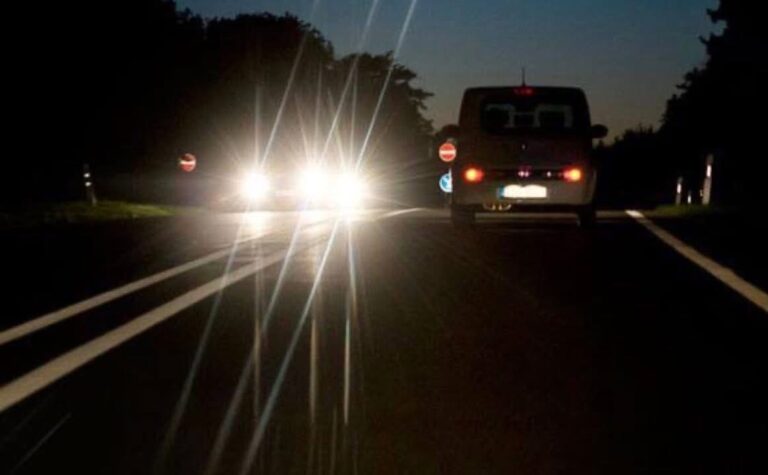
Illegal — Fine + Demerit PointUsing high beam on a street-lit road, or within 200 metres of an oncoming or preceding vehicle, is a direct breach of Regulation 218. This is the most commonly committed headlight offence — drivers who forget to dip to low beam when approaching oncoming traffic, or who drive on high beam through suburban streets. The regulation applies regardless of whether the other driver is visibly affected — the offence is in the use, not the result.
The 200 metre rule in practice: On an open dark road, switch to high beam when no other vehicles are visible. As soon as oncoming headlights appear or you close to within 200 metres of a vehicle ahead, dip to low beam. Make this automatic — not a response to the other driver flashing you in frustration.
Flashing high beam in frustration or aggression
Illegal — Road Rage RiskRepeatedly flashing high beam at a driver ahead — to pressure them to move, to express frustration, or as a road rage gesture — is an offence under Regulation 218 (dazzling another road user) and may attract additional charges under Summary Offences provisions if the behaviour is sustained or threatening. As with horn misuse, aggressive light flashing is also one of the most reliable triggers for road rage escalation from the targeted driver.
During the drive test: Any aggressive or inappropriate use of lights would be recorded as Other Illegal Action — a Critical Error. There is no situation in the drive test where flashing high beam at another vehicle is the correct response.
Using hazard lights while stopped on a road shoulder
Correct Use — RequiredHazard lights — both indicators flashing simultaneously — are correctly used when stopped on or beside a road due to a breakdown, emergency, or any situation where you are a potential hazard to other traffic. This is not just permitted — it is the expected and correct response. As covered in the fog driving guide, hazard lights should always be on when stopped on a road shoulder in poor visibility, combined with headlights on low beam.
Hazard lights while moving: Some drivers use hazard lights while driving slowly in heavy rain to make themselves more visible. In Victoria this is technically using hazard lights while moving — which can mask your turn signals. Better practice: ensure headlights are on low beam and drive at a speed appropriate to conditions.
The Drive Test Connection — Headlights Are Formally Assessed
⚡ This Is the Headlight Rule Most Learners Don't Know Until It's Too Late
"Low beam headlights must be on throughout both stages of the VicRoads drive test. The examiner directs the applicant to switch on headlights — specifically low beam — as part of the pre-drive safety check before the test begins. If I reminded an applicant once during the test to switch their headlights on, that was one warning. If I had to remind them a second time, the test terminated immediately. Not as a Critical Error — as an Immediate Termination. No third chance. Test over."
— Chamitha Lokuwithana, Ex-VicRoads Licence Testing Officer · Founder, Lessons2Drive
Headlights in the pre-drive safety check — exactly what happens:
1
Examiner directs: "Please switch on your headlights" — applicant activates high beam first
2
Examiner directs: "Now switch to low beam" — applicant switches to low beam
3
Low beam remains on for the entire duration of both stages — this is now the driver's responsibility
!
If lights are switched off during the test: one reminder allowed. Second reminder = Immediate Termination Error. Test ends on the spot.
Why low beam throughout? The criteria require low beam because it makes the vehicle visible to other road users without dazzling them — exactly the right balance for normal driving. High beam during the test, if used near other traffic, would be a road rules offence while under assessment. The low beam requirement is not a test technicality — it is the correct legal headlight setting for most driving conditions.
When to Use Each Headlight Setting — A Clear Reference
| Situation | Correct Setting | Reason |
|---|
| Driving in daylight | Low beam (DRLs for modern vehicles) | Visibility to others. High beam unnecessary in daylight. |
| Unlit road, no other vehicles within 200m | High beam | Maximum visibility ahead. Legal under Reg 218. |
| Oncoming vehicle within 200m or following within 200m | Low beam | Required by Reg 218. High beam causes dazzle. |
| Street-lit suburban road | Low beam | High beam prohibited on lit roads. Low beam sufficient. |
| Rain or reduced visibility | Low beam + fog lights if fitted | High beam reflects off rain droplets — reduces visibility. Low beam illuminates road surface correctly. |
| Fog | Low beam + front/rear fog lights | High beam creates glare wall. Low beam + fog lights maximise road illumination and visibility to others. |
| VicRoads drive test — both stages | Low beam — mandatory throughout | Required by criteria. One reminder permitted. Second reminder = Immediate Termination. |
Know the rules. Build the habits. Don't lose your test over a headlight.
Book a Lesson with Lessons2Drive
Every Lessons2Drive lesson covers the road rules and drive test criteria that matter — including headlight requirements, pre-drive check sequence, and everything else the examiner assesses from the moment you get in the car. Founded by an ex-VicRoads Licence Testing Officer. 304 five-star Google reviews.
📞 0400 008 706
✉ Info@Lessons2Drive.com.au
🌐 lessons2drive.com.au