
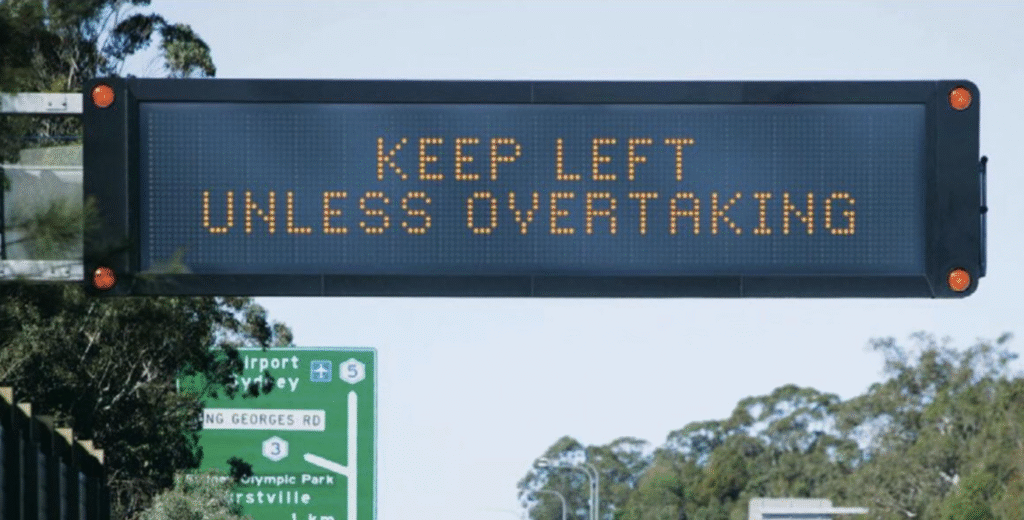
"Keep left unless overtaking" is one of the most widely misunderstood road rules in Victoria — not because it's complicated, but because most drivers apply a simplified version of it and don't know where that version breaks down. After 1,800+ official drive tests including Stage 2 assessments on high-speed arterial roads, I can tell you exactly what the rule requires, exactly where it applies, and exactly how it connects to the Lateral Position assessment item the examiner records on your score sheet.
There are actually two separate keep left obligations under Victorian road rules, not one. Most drivers conflate them. They are different rules with different triggers.
On a multi-lane road where the speed limit is more than 80 km/h, you must drive in the left lane unless you are overtaking, turning right, making a U-turn, avoiding an obstruction, or unless traffic conditions make it impractical. This rule applies automatically — no sign required. It applies on freeways, motorways, and high-speed divided roads.
Where a Keep Left Unless Overtaking sign is displayed, the same obligation applies regardless of the speed limit — including on roads with a 70 or 80 km/h limit if the sign is present. Signs can be posted on divided roads where the rule needs to apply below the automatic 80 km/h threshold. Always follow the sign where it exists.
What this means in practice: On most suburban arterial roads in Melbourne's west — Princes Freeway, Western Ring Road, Ballarat Road — where speed limits are 80–110 km/h, the keep left rule applies automatically. On urban multi-lane roads at 60–70 km/h, it applies only where a sign is posted. Not knowing the difference has caught many experienced drivers out.
Stage 2 of the VicRoads drive test uses multi-lane roads at 60–80 km/h. Lane position is formally assessed through two mechanisms — the Lateral Position task item assessed at each specific task, and the Lateral Position stage item assessed across the full duration of both stages.
"Stage 2 of the drive test moves onto multi-lane arterial roads — and lane discipline immediately separates students who've practiced on these roads from those who've stayed on quieter streets. The most common lateral position errors I recorded on multi-lane sections were: staying in the right lane after completing a right turn when the left lane was clear, failing to return to the left lane after an overtake on a faster road, and not using the left lane at all on a divided road — essentially treating the right lane as the default. None of these are aggressive or reckless behaviours. They're habits built during supervised practice on local streets where lane choice feels less important."
The keep left rule exists for three interconnected safety reasons — not bureaucratic ones.
When all drivers use the left lane as the default, traffic behaviour becomes predictable. A driver in the right lane is overtaking — other road users can anticipate this and respond accordingly. When drivers sit in the right lane without overtaking, the expected pattern breaks down — causing following drivers to brake, change lanes unexpectedly, or make frustrated decisions under pressure.
When a driver occupies the right lane at or below the speed limit, faster vehicles behind them cannot overtake on the right — it's the only legal overtaking direction. They either sit behind at close following distance, or they attempt to pass on the left — which is where most dangerous overtaking situations on multi-lane roads originate. The right lane sitter creates the hazard for everyone behind them.
Emergency vehicles approaching from behind at speed require the right lane to be clear for them to pass safely without weaving through traffic. Drivers who habitually occupy the right lane create an additional obstacle in exactly the situation where seconds matter most.
The rule requires keeping left unless overtaking — not unless someone faster wants to pass you. Travelling at the speed limit in the right lane when the left lane is clear is still a breach of the rule. Speed compliance and lane position are separate obligations.
Preparation for a right turn only justifies using the right lane when you are approaching the turn — not kilometres before it. The appropriate time to move to the right lane in preparation for a right turn is determined by traffic conditions and your approach speed, not by an extended "camping" strategy.
The automatic rule applies on any multi-lane road with a speed limit over 80 km/h — which includes many divided arterial roads, not just declared freeways. Where a Keep Left sign is posted, the rule applies regardless of speed limit. Many drivers are caught out on roads they don't consider freeways.
The rule applies regardless of whether other vehicles are present. This is relevant on the drive test — the examiner records your lane position as a habit, not just your response to traffic pressure. A student who moves to the left lane only when pressured by a vehicle behind demonstrates reactive rather than proactive lane discipline.
When returning to the left lane after overtaking or completing a right turn, the lane change must be performed correctly — the same criteria apply as for any lateral movement.
This sequence — internal mirror, external mirror, signal, head check, move — applies to every lateral movement of a car width or more, in both directions. It is the same sequence the VicRoads criteria assess for the Observation, Signalling, and Lateral Position items at every lane change task.
Stage 2 of your drive test uses arterial roads at 60–80 km/h. Lane discipline, lateral positioning, and the correct lane change sequence are all formally assessed. We teach these habits on the actual roads your VicRoads test will use. Founded by an ex-VicRoads Licence Testing Officer. 304 five-star Google reviews.
