
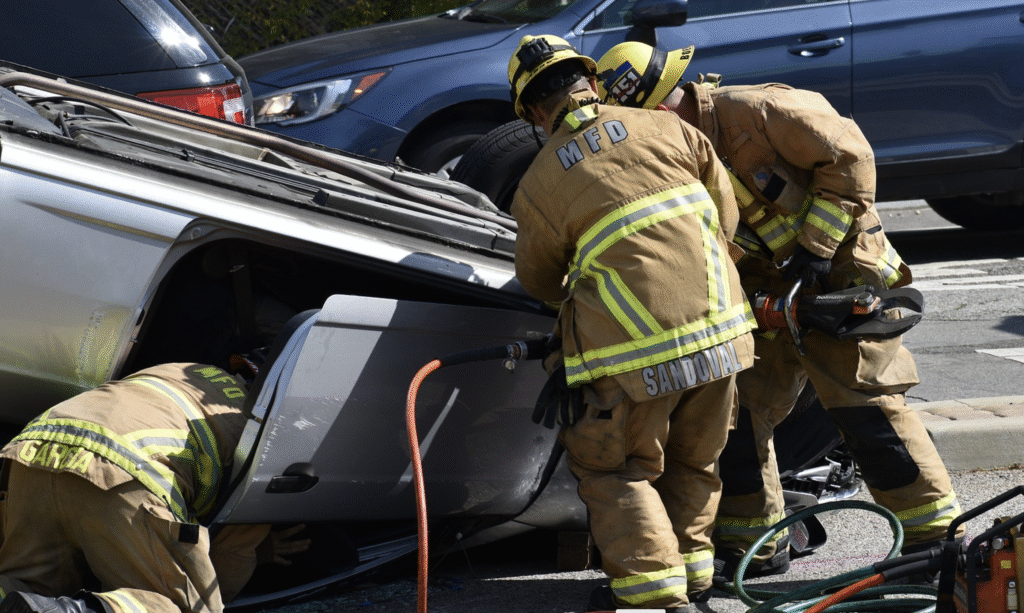
"They were sons, daughters, friends, family. And they never made it home."
This is not a marketing article. It's a genuine reflection on why road safety training exists, why it matters beyond a licence, and what the VicRoads drive test criteria were actually designed to protect. Every rule in that criteria manual has a reason. Every reason is a human life.
Victorian roads claimed over 200 lives in 2024. Across Australia, more than 1,200 people die on our roads every year. These are not abstract statistics. Behind every number is a family that lost someone — at an intersection, on a freeway, in a suburban street. Someone who left home that morning and didn't come back.
Young drivers — those aged 17 to 25 — are disproportionately represented in these figures. Not because young people are reckless, but because experience on the road is genuinely protective, and experience takes time to build. The first years of solo driving are statistically the most dangerous. This is not an opinion. It is why the Graduated Licensing System exists.
Note: Road toll figures change regularly. For current Victorian statistics, visit the TAC road toll page at tac.vic.gov.au.
The VicRoads criteria manual opens with this statement: VicRoads, with the help of Australian and international experts in novice driver safety, developed the drive test to help identify those learners who are ready to drive safely on their own.
Every element of the Graduated Licensing System — the 12-month minimum permit period, the 120 hours, the 20 night hours, the Hazard Perception Test, the two-stage drive test — was designed with one purpose: to reduce the number of people who don't come home. Here is what each element actually protects against.
Ensures learners experience driving across all four seasons — wet roads, reduced daylight in winter, school holiday traffic changes, summer heat affecting tyre pressure and driver fatigue. No single month of experience can replicate twelve. Each season brings conditions the driver will eventually face alone.
Research consistently shows that crash rates for young drivers decline significantly with supervised hours. The 120-hour requirement reflects the volume of varied experience needed to build the automatic responses that replace conscious thought in an emergency. A driver who has to think about what to do when a hazard appears has already lost a fraction of a second that matters.
Crashes are disproportionately likely at night — reduced visibility, fatigue, and the presence of intoxicated pedestrians and drivers all contribute. The mandatory 20 night hours ensure that a new driver's first solo night driving experience is not also their first night driving experience. That distinction protects them and everyone else on the road with them.
Hazard perception is the ability to identify a developing danger before it becomes an emergency. The research shows that this skill — identifying hazards earlier — is directly correlated with lower crash rates. The HPT doesn't test whether you can react to a crisis. It tests whether you can see one forming in time to avoid it entirely.
Stage 1 in lower-risk environments specifically filters out learners who would be unsafe in the more complex situations of Stage 2 before they encounter those situations. This staged approach means that potentially unsafe drivers are identified and given the opportunity to continue learning before they are placed in higher-risk traffic environments — both on test day and after they receive their licence.
When a Licence Testing Officer records an assessment item on a drive test score sheet, they are not applying an arbitrary standard. Every item has a documented safety rationale. Here is what each one protects against in real-world driving.
Continuous scanning, mirror checks before braking, head checks before lateral movement — these prevent collisions with vehicles and road users that are present but not yet seen. Most serious crashes involve a driver who didn't see what they hit in time to stop.
Signalling 3 seconds before turning or changing lanes gives other drivers, cyclists, and pedestrians time to respond to your intended movement. The 5-second rule from a stationary position accounts for the additional time needed for someone approaching from further away.
Selecting the first available safe gap — and rejecting unsafe ones — prevents T-bone and head-on collisions at intersections. Intersection crashes are among the most deadly because of the angles involved and the speeds at which they occur.
Speed is the single most significant factor in both crash likelihood and crash severity. The difference between 60 km/h and 70 km/h is not 10 km/h of impact. At higher speeds, stopping distances increase exponentially and the energy transferred in a crash rises dramatically.
The 2-second gap — 3 seconds in poor conditions — is the minimum space needed for a driver to perceive a hazard ahead, process it, decide to brake, and apply the brakes before reaching the hazard. Rear-end collisions are almost entirely a following distance failure.
Correct road positioning — including the 1.2 metre clearance from parked vehicles — protects against dooring crashes, pedestrians stepping from between parked cars, and head-on collisions from drifting across the centre line. These are not minor incidents.
"I conducted over 1,800 official drive tests. I recorded every error on a score sheet — Critical Errors, Immediate Termination Errors, task items. I did my job carefully and applied the criteria consistently. But I was always aware of what the criteria were for. Not to fail students. To identify, before they drove alone, whether the habits they'd built were safe enough to protect them and the people around them. Every standard I applied was there because someone, somewhere, hadn't met it — and something terrible happened."
"I started Lessons2Drive because I saw, from that examiner's seat, exactly what the difference was between a prepared driver and an unprepared one. Not just in their test result — in how they would drive for the rest of their lives. The habits built in those 120 hours are the habits they carry into every night drive, every wet road, every moment of distraction. Getting those habits right from the start is not about passing a test. It's about coming home."
Involved in approximately one third of all fatal crashes. Even moderate excess speed dramatically reduces the time available to respond to hazards and increases impact energy.
Speed Choice assessment item. Excessive Speed Immediate Termination Error. School zone zero tolerance. The habit of checking speed against limits continuously — built through structured, criteria-aware practice.
Particularly significant for young drivers on country roads and late-night driving. Impairs hazard perception, reaction time, and decision-making in ways that mirror alcohol impairment.
Hazard Perception Test builds awareness of reduced capacity states. Night driving hours build familiarity with conditions when fatigue risk is highest. Graduated licence restrictions on late-night solo driving for P-platers.
Mobile phone use while driving is now a leading crash factor, particularly among younger drivers. Any visual distraction removes the continuous scanning the Observation criteria require.
Observation assessment item penalises any break in continuous lookout. The habit of continuous scanning — built to pass the test — is the same habit that makes distraction obvious and unnatural for a well-trained driver.
New drivers have not yet built the pattern recognition that allows experienced drivers to anticipate hazards before they develop. This is the primary reason young drivers crash at higher rates regardless of speed or alcohol.
The 120 hours of supervised practice. The Hazard Perception Test. Structured professional lessons that teach the driver to scan, anticipate, and respond — not just to react. The quality of those hours matters as much as the quantity.
A significant proportion of serious urban crashes occur at intersections — particularly during turns and at give way situations. These involve a failure to correctly assess approaching traffic speed and distance.
Gap Selection assessment item. Fail to Give Way Immediate Termination Error. The drive test criteria specifically require correct observation in all give way situations — and practice on real test routes builds this in the actual intersection environments where it matters.
The research is consistent: the quality of supervised driving hours matters as much as the quantity. Young drivers who received structured, skill-focused supervised practice — particularly in varied conditions including arterial roads, adverse weather, and night driving — show significantly lower crash rates in the first two years of solo driving compared to those who accumulated hours primarily in low-risk environments.
Professional driving lessons — particularly those taught by instructors who understand the VicRoads assessment criteria — contribute to lower first-year crash rates not because they help students pass the test, but because the habits built to pass the test are the same habits that prevent crashes.
The mirror check before braking that prevents a rear-end collision from a vehicle behind. The head check that prevents a lane change into a vehicle in the blind spot. The 2-second following distance that provides the stopping distance needed when the car ahead brakes suddenly. These are not test requirements. They are survival behaviours.
"They were sons, daughters, friends, family. And they never made it home."
Every driving instructor, every road safety researcher, every Licence Testing Officer, every parent supervising a learner — we are all working toward the same thing. Not a pass rate. Not a statistic. The simple outcome that the person who left home comes back.
The VicRoads drive test criteria were designed with expert advice specifically to identify which drivers are ready to do that safely. Understanding them — really understanding them, not just enough to pass — is how every new driver honours the people who didn't make it home, and ensures they will.
At Lessons2Drive, we teach to the VicRoads criteria because we believe understanding those criteria — deeply, not just enough to pass — is how a new driver protects themselves and everyone else on the road. If you'd like to talk about what that looks like for your learner driver, we're here.
