Written by
Chamitha Lokuwithana — Ex-VicRoads Licence Testing Officer
1,800+ official drive tests conducted · Founder, Lessons2Drive
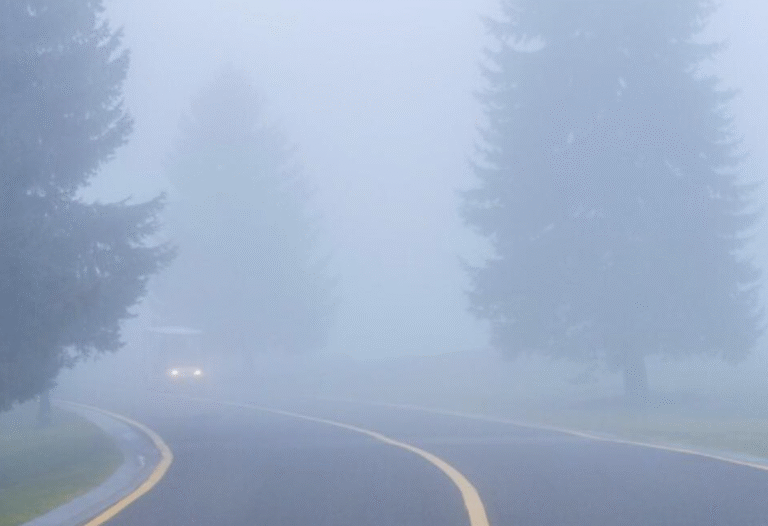
Fog is one of the most genuinely dangerous driving conditions — not because it creates new hazards, but because it removes your ability to see the ones that are already there. For learner drivers in Melbourne's west, fog is a real and regular occurrence — particularly in low-lying areas around Werribee, Melton, and the Werribee River corridor in autumn and winter mornings. Understanding exactly how to drive in it, and what the VicRoads criteria say about visibility-related assessment items, is what this guide covers.
Where Fog Occurs in Melbourne's West and North
Fog in Melbourne's west and north forms most commonly on clear, calm, cold nights and early mornings — particularly after rain has moistened the ground. It tends to pool in low-lying areas and near waterways.
Werribee and surrounds — flat low-lying land near the Werribee River, frequent autumn fog
Melton and Bacchus Marsh — valley fog common in still, cold mornings
Sunbury and Macedon ranges — elevated areas can generate fog that descends onto roads
Western Ring Road and Princes Freeway — patchy fog patches at speed create sudden visibility changes
⚡ How Fog Affects the VicRoads Drive Test Assessment Items
The drive test can and does proceed in light fog — examiners do not cancel tests for weather conditions unless conditions are genuinely unsafe. If fog is present during your test, three specific assessment items are directly affected.
Speed Choice — reduced speed is accepted when visibility justifies it
The criteria state that driving below the speed limit is not penalised when road or traffic conditions make it unsafe to drive at the limit. Reduced visibility from fog is a genuine condition that justifies reduced speed — but the speed must be proportionate to the actual visibility, not just nervousness.
Following Distance — 3 seconds minimum in poor conditions
In fog, your ability to see hazards ahead is reduced — which means you need more time to react when something does appear. The criteria require at least 3 seconds following distance in poor conditions. In dense fog, increase this further. The examiner watches your following distance throughout straight drives in both stages.
Observation — continuous lookout is maintained, mirrors checked before braking
Fog does not change the Observation requirements — you must still maintain a continuous lookout ahead, check mirrors before braking, and look in all required directions at give way situations. What changes is that the information available from your lookout is reduced — which is exactly why increased following distance and reduced speed matter.
How to Drive Safely in Fog — Eight Specific Rules
1
Low Beam Headlights — Not High Beam, Not Parking Lights
In fog, use low beam headlights. High beams cause the light to reflect off the water droplets in the fog, creating a bright wall of glare that actually reduces visibility rather than improving it. Parking lights alone are insufficient — they make your car visible but don't illuminate the road adequately. Low beam is the correct setting in fog regardless of the time of day.
VicRoads drive test connection: The criteria require low beam headlights to be on throughout both stages of the drive test — a rule the examiner specifically directs at the start. In foggy conditions this is not just a test requirement — it is the correct technique for visibility and being seen.
2
Use Fog Lights If Fitted — and Turn Them Off When Fog Clears
Front fog lights are positioned lower on the vehicle than standard headlights — below the fog layer — which allows them to illuminate the road surface without reflecting off the fog above. If your vehicle has front and rear fog lights, use them when visibility is significantly reduced by fog. Rear fog lights make your vehicle visible to drivers behind you who may not see your tail lights in time.
Important: Turn fog lights off once the fog clears. Rear fog lights are significantly brighter than standard tail lights and can blind or distract drivers behind you in normal conditions. Using them when fog is not present can also attract attention from police under Victorian road rules.
3
Drive at a Speed at Which You Can Stop Within Your Visible Distance
This is the fundamental fog driving rule: if you cannot stop within the distance you can see clearly ahead, you are driving too fast for the conditions — regardless of the posted speed limit. In light fog where you can see 60 metres ahead, your speed must allow you to stop within 60 metres. In heavy fog where visibility drops to 20 metres, your speed must allow stopping within 20 metres. This requires significantly lower speeds than normal.
For learner drivers: Practice estimating your stopping distance at different speeds. At 60 km/h in good conditions, your total stopping distance (reaction time plus braking) is approximately 45–50 metres. In fog with reduced road grip, this increases. Fog doesn't just reduce what you can see — it often also means damp roads, which extend your braking distance.
4
Increase Following Distance to at Least 3–4 Seconds
The VicRoads criteria already require 3 seconds following distance in poor conditions — and fog qualifies as poor conditions. In dense fog, increase this to 4 seconds or more. The vehicle ahead of you may brake for a hazard you cannot yet see. Your only protection is the space between you and them. Following too close in fog is one of the most common causes of multi-vehicle rear-end crashes.
Do not follow the tail lights of the car ahead as a navigation guide. This is a common but dangerous behaviour — you are not seeing the road, you're tracking the car, and if they brake suddenly or drive off the road, you have no independent information. Use the road markings and your own visibility to navigate.
5
Smooth Inputs — No Sudden Braking or Sharp Steering
Fog is frequently accompanied by surface moisture — either from overnight dew, light rain, or the condensation that settles on road surfaces in foggy conditions. This means the road is likely to be slippery as well as the visibility reduced. The same smooth control inputs the VicRoads criteria assess throughout both stages — gentle acceleration, progressive braking, steady steering — are even more important in fog. Sudden inputs reduce traction on damp surfaces.
Check your mirrors before braking — a requirement in the VicRoads Observation criteria — is particularly important in fog. A driver behind you may be following too close and may not see you brake in time. An early check gives you the information to brake progressively rather than abruptly.
6
Beware of Patchy Fog — Sudden Visibility Changes at Speed
One of the most dangerous fog situations is patchy fog at higher speeds — common on freeways and arterial roads like the Western Ring Road and Princes Freeway. You may be driving in clear conditions and then enter a dense fog patch within seconds, reducing visibility from hundreds of metres to less than 20 metres almost instantly. This is when drivers who have not already slowed down are most at risk.
What to do: If you see fog ahead on a freeway or high-speed road, reduce your speed before you enter it — not as you enter it. Check traffic reports via VicTraffic before freeway journeys in cold, still mornings. If fog is forecast or reported, consider an alternate route or allow extra time to drive at reduced speed.
7
Use Road Markings to Navigate — Not the Car Ahead
In fog, road markings — edge lines, centre lines, lane markings — are your most reliable reference for position. Keep your lateral position relative to these markings, not relative to other vehicles. On multi-lane roads, position yourself within your lane using the markings visible in your low beam headlights. This is the same Lateral Position requirement the VicRoads criteria assess — fog doesn't change it, but it makes following it more deliberately important.
8
If You Must Pull Over — Do It Completely and Correctly
If fog becomes too dense to drive safely, pulling over is the right decision. But how you do it matters. Signal before you move toward the shoulder. Pull completely off the road surface — not partially in a lane. On a road with a shoulder or emergency stopping lane, pull as far left as possible.
Important correction from some general advice: Do NOT turn your headlights off when stopped on a road shoulder in fog. Keep your headlights on low beam and turn your hazard lights on. A vehicle stopped with no lights in fog is invisible and extremely dangerous. Your headlights and hazard lights together make you as visible as possible to approaching traffic. Only turn your headlights off if you are completely off the road in a designated rest area or car park.
Check traffic reports before resuming — if the fog is a weather event affecting a large area, it may clear naturally within 20–30 minutes as the morning warms. Waiting briefly in a safe position is almost always preferable to continuing in dangerous visibility.
⚡ From the Examiner's Seat — What Fog Reveals About a Driver
"Fog is an interesting condition to assess in, because it reveals exactly how automatic a driver's habits are. A driver who genuinely has good observation habits maintains them in fog — the eyes still move, the mirrors still get checked before braking, the following distance adjusts naturally. A driver who was performing those habits consciously for the examiner starts to drop them when the fog creates additional cognitive load. The best preparation for driving in difficult conditions is not specific fog training — it's building the correct habits so automatically that they persist under pressure."
— Chamitha Lokuwithana, Ex-VicRoads Licence Testing Officer · Founder, Lessons2Drive
For Learner Drivers — Should You Drive in Fog?
Yes — with appropriate supervision and in appropriate conditions. Light fog that reduces visibility to 100 metres or more is a valuable supervised practice condition. Dense fog where visibility drops below 50 metres is not appropriate for learner drivers and supervised sessions should be delayed until it clears.
The VicRoads GLS encourages practice in varied conditions, and foggy conditions build exactly the skills that are most transferable: the 3-second following distance becomes habitual, smooth inputs become natural, headlight use becomes automatic, and observation habits are tested under real pressure.
For parents supervising: use light fog sessions on familiar local roads first — not freeways or unfamiliar routes. The goal is building confidence in the technique, not introducing multiple new variables at once.
Fog Driving Quick Reference
Lights: Low beam on · High beam off · Fog lights if fitted
Speed: Stop within visible distance · Reduce before fog patches
Distance: Minimum 3–4 seconds · Do not follow tail lights
Inputs: Smooth acceleration · Progressive braking · Mirror before braking
Navigation: Use road markings · Not other vehicles
Stopped: Fully off road · Headlights ON · Hazards ON
Build the habits that hold in any conditions
Learn with Lessons2Drive — Melbourne's West and North
Our instructors teach on the real roads your learner driver will face — including the arterial roads, intersections, and weather conditions of Melbourne's west. Every habit we build is grounded in the VicRoads assessment criteria. Founded by an ex-VicRoads Licence Testing Officer. 304 five-star Google reviews.
📞 0400 008 706
✉ Info@Lessons2Drive.com.au
🌐 lessons2drive.com.au