Written by
Chamitha Lokuwithana — Ex-VicRoads Licence Testing Officer
1,800+ official drive tests conducted · Founder, Lessons2Drive
A seatbelt takes about three seconds to fasten. In a collision at 60 km/h, the time between impact and the car stopping is approximately 0.15 seconds. That gap — between the three seconds it took to protect yourself and the 0.15 seconds you have to survive — is one of the clearest arguments in road safety. But beyond the physics, seatbelt law in Victoria is more specific than most drivers know. This guide covers what the law actually requires, what the VicRoads drive test checks, and what happens when a seatbelt is worn incorrectly.
Why Seatbelts Work — The Physics in Plain Language
When a car hits something and stops, the car decelerates to zero in a fraction of a second. But your body, without a seatbelt, continues moving at the speed the car was travelling — until it hits the steering wheel, dashboard, windscreen, or is ejected through it. This is Newton's first law applied to a crash.
A seatbelt does two things simultaneously. It prevents you from continuing forward — stopping your body before it reaches the hard surfaces inside or outside the vehicle. And it distributes the deceleration force across the strongest parts of your skeleton — the hips and shoulders — rather than concentrating it on your head, neck, or chest.
An unbuckled driver or passenger in a collision also becomes a hazard to everyone else in the vehicle. At 60 km/h, an unrestrained person effectively becomes a 70+ kg projectile moving at high speed inside the cabin — capable of seriously injuring or killing other occupants even in collisions that might otherwise be survivable.
⚡ The Seatbelt and the VicRoads Drive Test
The seatbelt appears in the VicRoads drive test in a specific and important way. Before the test begins, the Licence Testing Officer directs the applicant to start the engine. The applicant is expected to fasten their seatbelt as part of the pre-drive setup — before the engine starts and before any movement. This is not a scored item, but it is observed.
More significantly: driving without a seatbelt during the drive test is an illegal action. The VicRoads criteria define an Immediate Termination Error (Other Dangerous Action) as any action that causes immediate danger to road users or property, or unnecessarily increases the risk of a collision. Driving unbelted, if observed, falls under the Other Illegal Action Critical Error category at minimum — and depending on the circumstances could escalate further.
In practice: the examiner will check that the applicant is belted before the car moves. But the habit of belting up automatically — before you start the engine, without being reminded — is what the pre-drive check is designed to reveal.
Victorian Seatbelt Law — What Most Drivers Don't Know
Most people know you must wear a seatbelt. Far fewer know the specific legal requirements that determine exactly when, how, and for whom seatbelts are legally required in Victoria. Here are the provisions that matter.
1
The Driver Is Responsible for All Passengers Under 16
In Victoria, the driver is legally responsible for ensuring that all passengers aged under 16 are correctly restrained. If a child passenger is unbelted and the vehicle is stopped by police, it is the driver who receives the infringement — not the child's parent if they happen to be a passenger, and not the child themselves. This is one of the most commonly misunderstood aspects of seatbelt law.
Practical implication: If you are driving with young passengers and someone else is supervising them in the back seat, you are still the person legally required to confirm they are belted before moving. Do not assume someone else has checked. It is your licence and your infringement.
2
Child Restraint Requirements — Age and Weight Specific
Victorian road rules specify different restraint requirements based on a child's age and weight. Using the wrong restraint type for a child's size is an infringement even if the child is restrained. The requirements are:
👶Under 6 months: Rearward-facing restrained infant seat
🧒6 months to under 4 years: Rearward-facing or forward-facing restrained seat with inbuilt harness
👦4 years to under 7 years: Forward-facing restrained seat with inbuilt harness or booster seat with lap-sash seatbelt
🧑7 years to under 16 years: Booster seat with lap-sash seatbelt, or where unavailable, a properly adjusted seatbelt
Always check current VicRoads requirements: Child restraint rules can be updated. Verify current requirements at vicroads.vic.gov.au before purchasing a restraint or transporting children. The requirements above are a guide — specific weight thresholds and transitional rules apply.
3
Passengers 16 and Over Are Responsible for Themselves
Passengers aged 16 and over are legally responsible for their own seatbelt compliance in Victoria. If an adult passenger is caught unbelted, the infringement goes to that passenger — not the driver. However, as the driver you cannot start moving if you know a passenger is unbelted — and practically speaking, you should not. Make it a standard practice to confirm all passengers are belted before moving, regardless of who the legal responsibility falls to.
For learner drivers specifically: As a learner, you are building habits. The habit of checking that all passengers are belted before moving is the same habit that will protect your passengers for the rest of your driving life. Build it now — not later.
4
Wearing It Incorrectly Is an Offence — Not Just Wearing One
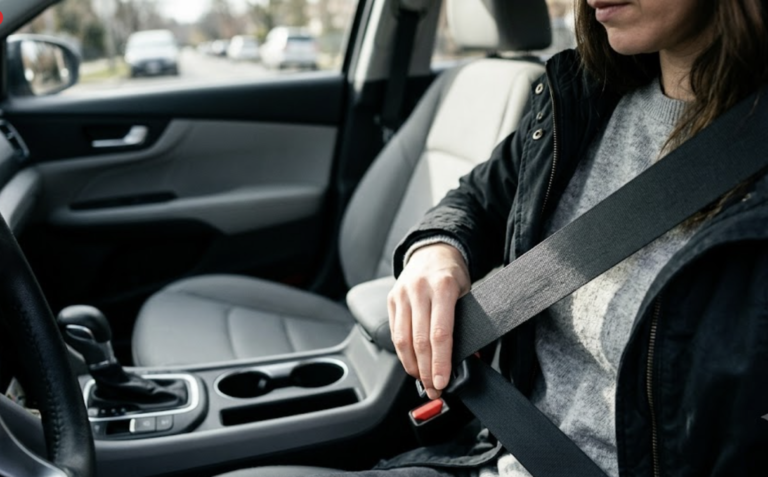
Victorian road rules require that a seatbelt is worn correctly — not simply present. Wearing a seatbelt incorrectly can result in an infringement and, more importantly, dramatically reduces or eliminates the protection the belt provides in a collision.
❌ Incorrect — Offence and Dangerous
Lap belt only, with shoulder strap behind your back
Shoulder strap tucked under your arm
Shoulder strap across your neck rather than your shoulder
Belt worn over bulky clothing that prevents proper fit
✓ Correct
Lap portion across hips — not across the stomach
Shoulder strap across the chest and over the shoulder
Belt snug but not tight — no slack or twisting
Worn directly over clothing — not over a heavy coat
Why tucking the shoulder strap behind you is so dangerous: The shoulder strap is responsible for the upper body deceleration in a frontal crash. Without it, your upper body pitches forward freely while your hips are held by the lap belt — concentrating enormous force on your abdominal organs and lower spine. This is a pattern of injury associated specifically with incorrectly worn seatbelts rather than no seatbelt at all.
5
Medical Exemptions — What Is and Isn't Permitted
Victoria allows medical exemptions from seatbelt requirements in limited circumstances — typically where wearing a seatbelt is medically inadvisable due to a specific condition or recent surgery. These exemptions require a certificate signed by a registered medical practitioner and must be carried in the vehicle. A verbal claim of a medical exemption during a police stop is not sufficient. The certificate must be presented.
Exemptions do not apply to learner drivers sitting the VicRoads drive test — if a medical condition prevents a candidate from wearing a seatbelt, the test cannot proceed as the vehicle cannot be driven legally on public roads without the driver wearing one.
⚡ From the Examiner's Seat
"Before every test I conducted, the applicant fastened their seatbelt. It sounds obvious. But what I was watching was not whether they put it on — it was how they put it on. Was it automatic, part of a sequence, done before they touched anything else? Or was it an afterthought, done after I prompted them to start the engine? The seatbelt habit is one of the earliest indicators of whether a student's safety routines are ingrained or performed."
"I also want to say this clearly: I saw the results of crashes involving unbelted occupants in my time in road safety. The data is unambiguous. The seatbelt is not about avoiding a fine. It is the single most effective thing you can do to survive the crash you haven't had yet."
— Chamitha Lokuwithana, Ex-VicRoads Licence Testing Officer · Founder, Lessons2Drive
Building the Seatbelt Habit — Before You Start the Engine
The goal is not to remember to put your seatbelt on. The goal is for it to be so automatic that you notice immediately if you haven't — the same way you'd notice immediately if you sat down without your phone in your pocket.
Build this sequence until it requires no conscious thought:
1
Get in and close the door
2
Fasten seatbelt — correctly, across shoulder and hips
3
Confirm all passengers are restrained
4
Adjust seat and mirrors if needed
This sequence — seatbelt before engine — is what the VicRoads pre-drive check is designed to observe. It is also the sequence that ensures you never drive away unbuckled because you forgot during the engine-starting process.
Victorian Seatbelt Quick Reference
Driver responsibility: All passengers under 16. Adult passengers responsible for themselves.
Incorrect wear: An offence even if the belt is present. Shoulder strap behind you or under arm = infringement + danger.
Child restraints: Age and weight specific. Wrong restraint type = infringement. Driver responsible.
Drive test: Belt before engine. Observed as part of pre-drive check. Driving unbelted = illegal action.
Medical exemptions: Written certificate from registered medical practitioner required and must be carried.
Correct fit: Lap portion over hips. Shoulder strap over shoulder and across chest. Snug, no slack.
Build safety habits that last a lifetime
Book a Lesson with Lessons2Drive
From the pre-drive check to the final assessment, every Lessons2Drive lesson teaches the safety habits that VicRoads criteria require and real roads demand. Founded by an ex-VicRoads Licence Testing Officer. All instructors hold Working With Children Check. 304 five-star Google reviews.
📞 0400 008 706
✉ Info@Lessons2Drive.com.au
🌐 lessons2drive.com.au