Written by
Chamitha Lokuwithana — Ex-VicRoads Licence Testing Officer
1,800+ official drive tests conducted · Founder, Lessons2Drive
Give way rules are the most heavily assessed category in the VicRoads drive test criteria — and the most dangerous to get wrong. Failing to give way when another road user takes evasive action is an Immediate Termination Error that ends the test on the spot. On real roads, the same failure is among the leading causes of serious intersection crashes. After 1,800+ official drive tests, I can tell you exactly which give way situations trip students up, why, and what the law actually requires in each one.
⚡ Give Way in the VicRoads Drive Test Criteria
Give way situations are assessed through three specific criteria items. Understanding all three is essential before sitting the test.
Gap Selection — Task Assessment Item
Assessed at every give way situation — turning at intersections, entering roundabouts, merging, and changing lanes. Requires selecting the first available safe gap after an initial observation period. Waiting too long through safe gaps is also penalised — Gap Selection assesses both unsafe entry and unnecessary delay.
Fail to Look — Critical Error
Recorded when the driver does not look for conflicting traffic before proceeding at a give way situation — even if no conflicting traffic is present. The criteria require looking, not just proceeding safely. Fail to Look is a Critical Error: more than one in Stage 1, or more than two across the full test, ends the result.
Fail to Give Way — Immediate Termination Error
If the driver proceeds at a give way situation and another road user — driver, cyclist, or pedestrian — takes evasive action (brakes, swerves, or accelerates to avoid a collision), the test ends immediately. No recovery. No second chance. This is the most serious give way error and it ends the test the moment it occurs.
Give Way Rules in Victoria — Every Situation Covered
1
Give Way Signs
Inverted red and white triangle — must slow and give way to all traffic on the road you are entering
At a Give Way sign, you must slow or stop if necessary and give way to any vehicle on the road you are about to enter. Unlike a Stop sign, you are not required to bring the vehicle to a complete stop if the road is clear — but you must be prepared to stop if traffic requires it. Creeping through a Give Way at speed without genuinely assessing traffic is exactly what the Fail to Look Critical Error and Fail to Give Way Immediate Termination Error are designed to capture.
Drive test requirement: Look right, look left, look right again at the Give Way approach. The criteria require looking for conflicting traffic — not just slowing down. A student who slows and enters without clearly scanning has committed a Fail to Look Critical Error even if the road happened to be clear.
2
T-Intersections — Give Way to Through-Road Traffic
The road that ends gives way — even without a sign present
At a T-intersection without any signs or traffic lights, the driver on the road that ends (the top of the T) must give way to all vehicles on the continuing road (the through road). This rule applies even if there is no Give Way sign present. Many learner drivers — and experienced drivers — are surprised by this. If you are on the road that dead-ends into another, you give way.
Common confusion: If both roads continue (a cross-intersection with no signs), different rules apply — the give way to the right rule. But at a T-intersection specifically, the terminating road always gives way to the through road regardless of direction.
3
Cross-Intersections Without Signs — Give Way to the Right
No signs, no lights — the vehicle on the right has priority
At a cross-intersection where no signs or traffic lights control the intersection and both roads continue, you must give way to any vehicle approaching from your right. This is the "give way to the right" rule. It applies when both drivers arrive at the intersection at roughly the same time and neither has a clear right of way from signage.
Important: This rule only applies when no other control exists. If there is a Give Way or Stop sign, or traffic lights — those controls override the give way to the right rule. Students who apply give way to the right at a controlled intersection are misapplying the rule.
4
Turning Right — Give Way to Oncoming Traffic and Pedestrians
One of the most assessed give way situations in the drive test
When turning right at any intersection — with or without traffic lights — you must give way to oncoming vehicles travelling straight or turning left. You must also give way to any pedestrians crossing the road you are turning into. This is one of the most heavily assessed give way situations in the drive test because it involves multiple potential conflict points simultaneously: oncoming vehicles, vehicles turning left from the opposite direction, and pedestrians.
Give way to:
✓ Oncoming vehicles going straight
✓ Oncoming vehicles turning left
✓ Pedestrians crossing the road you are turning into
Common error:
Waiting only for oncoming vehicles then turning without checking for pedestrians who may have started crossing. Pedestrian evasive action ends the test immediately.
At a green traffic light: A green light gives you permission to proceed — it does not give you right of way over oncoming traffic when turning right. You must still wait for a safe gap in oncoming traffic before completing the turn.
5
Roundabouts — Give Way to All Traffic Already in the Roundabout
Plus specific signalling rules assessed separately
At a roundabout, you must give way to all vehicles already travelling within the roundabout — regardless of which direction they are coming from. You do not give way to vehicles entering from other entry points at the same time as you. The priority is specifically for vehicles already circulating inside the roundabout.
Roundabout signalling — assessed separately in the drive test:
→First exit (less than halfway): Left signal on entry, cancel on exit
→Straight (approximately halfway): No signal on entry, left signal before your exit
→More than halfway around: Right signal on entry, left signal before your exit
The most common roundabout error: Entering the roundabout while a vehicle is already in it — even if that vehicle is some distance away. The criteria do not require the other vehicle to be immediately beside you to constitute a Fail to Give Way. If the other vehicle has to adjust their speed or direction because of your entry, that is evasive action.
6
Turning Left — Give Way to Pedestrians and Cyclists
Including pedestrians who have started crossing before you begin your turn
When turning left, you must give way to any pedestrian crossing the road you are turning into, and to any cyclist travelling in the same direction as you in a bicycle lane. The pedestrian give way obligation applies whether or not the pedestrian has a green pedestrian signal — if they have started crossing, you must wait for them to clear.
Drive test connection: A pedestrian on a crossing who has to stop, step back, or change pace because of your left turn constitutes evasive action — Immediate Termination. Look specifically for pedestrians who may have begun crossing before you arrived at the intersection.
7
Merging — Give Way to Vehicles Already in the Lane
The vehicle merging gives way — not the vehicle already in the lane
When merging into a lane — whether from a slip road, a lane that ends, or an on-ramp — you must give way to vehicles already travelling in the lane you are entering. The vehicle already in the lane has priority; the vehicle merging must find a safe gap and adjust their speed to enter smoothly. Where lane markings end (a zip merge), vehicles take turns — but the principle of not forcing another driver to brake or swerve still applies.
Drive test context: Merging is assessed in Stage 2 on arterial roads. The Gap Selection item requires selecting the first available safe gap — forcing your way into a gap that causes the following vehicle to brake is a Fail to Give Way, regardless of whether physical contact occurs.
8
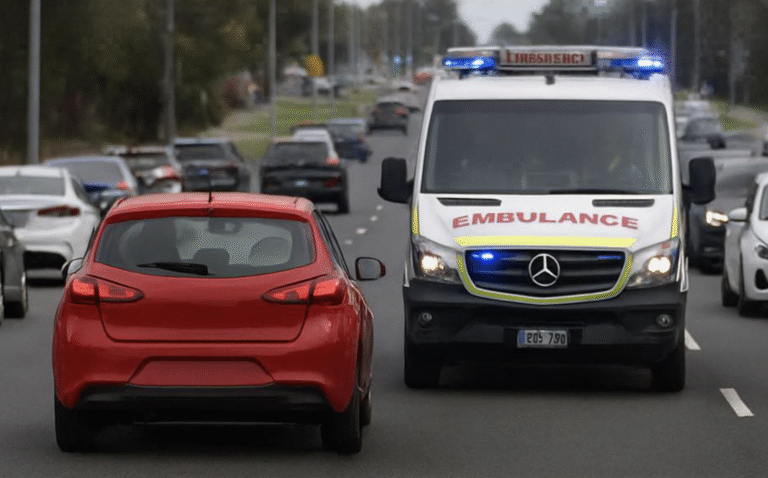
Emergency Vehicles — Give Way Immediately
Flashing blue or red lights, or siren sounding — you must move clear
When an emergency vehicle — ambulance, police, fire — is displaying flashing lights or sounding a siren, you must give way immediately. Move to the left of the road as safely as possible and stop until the emergency vehicle has passed. The law is clear: if you are in the path of an emergency vehicle and fail to move, you are committing an offence — regardless of the reason.
Check mirrors first: Identify the direction the emergency vehicle is approaching from before moving. Moving suddenly without checking can create a hazard for other drivers reacting to the same vehicle.
At a red light or Stop sign: You may carefully proceed past the stop line or red light to clear the path — but only if it is safe to do so. After the emergency vehicle passes, resume obeying traffic signals.
Do not: Speed up to clear the intersection, stop suddenly without warning, or drive onto a median strip or footpath to give way.
The human reality behind this rule: When an ambulance is delayed by traffic that doesn't move, the person waiting for it at the other end is someone's family member. Every second of response time has documented effects on survival rates for cardiac events, strokes, and serious trauma. Giving way to emergency vehicles is not a courtesy — it is a legal obligation with a direct human consequence.
⚡ From the Examiner's Seat — The Give Way Errors I Saw Most
"Give way failures were the single most common cause of Immediate Termination Errors I recorded across 1,800+ drive tests. And almost none of them involved students who didn't know they needed to give way. They knew. What they failed to do was look correctly before proceeding — either they looked in the wrong direction, looked too early and didn't re-check before moving, or their observation was technically present but visually inadequate. The head turned, but the eyes didn't actually scan the space."
"The right turn gave me the most concern. Students who had waited patiently for oncoming traffic, then turned the moment the last car passed — without checking the pedestrian crossing they were about to enter. Pedestrians who had started crossing during the wait were directly in their path. That is an Immediate Termination Error. And on a real road, it is an incident."
— Chamitha Lokuwithana, Ex-VicRoads Licence Testing Officer · Founder, Lessons2Drive
The Observation Sequence at Give Way Situations
The VicRoads criteria require specific observation at every give way situation. This sequence must become automatic — not performed, not remembered, but reflexive.
1
Check mirrors — what is behind you and to the sides
2
Scan for conflicting traffic in all relevant directions — look right, left, right for most intersections
3
Check for pedestrians on any crossing you are about to cross or enter
4
Identify a safe gap — first available, not the most comfortable one
5
Re-check the direction of most concern immediately before moving — not 3 seconds earlier
6
Proceed smoothly into the available gap — hesitation through multiple safe gaps is also penalised
Give Way Quick Reference
| Situation | Give Way To | Drive Test Error if Wrong |
|---|
| Give Way sign | All traffic on the road you are entering | Fail to Give Way (ITE) |
| T-intersection (no sign) | All vehicles on the through road | Fail to Give Way (ITE) |
| Cross-intersection (no sign) | Vehicle approaching from your right | Fail to Give Way (ITE) |
| Turning right | Oncoming vehicles + pedestrians crossing destination road | Fail to Give Way (ITE) |
| Roundabout | All vehicles already circulating in the roundabout | Fail to Give Way (ITE) |
| Turning left | Pedestrians crossing + cyclists in bicycle lane | Fail to Give Way (ITE) |
| Merging | Vehicles already in the lane you are entering | Fail to Give Way (ITE) |
| Emergency vehicle | Ambulance, police, fire — flashing lights or siren | Other Illegal Action (CE) |
Build the give way habits that protect you for life
Train with Lessons2Drive — Melbourne's West and North
Every Lessons2Drive lesson teaches give way rules against the actual VicRoads assessment criteria — on real intersections and roundabouts on the routes your drive test will use. Founded by an ex-VicRoads Licence Testing Officer who assessed give way situations 1,800+ times. 304 five-star Google reviews.
📞 0400 008 706
✉ Info@Lessons2Drive.com.au
🌐 lessons2drive.com.au