Written by
Chamitha Lokuwithana — Ex-VicRoads Licence Testing Officer
1,800+ official drive tests conducted · Founder, Lessons2Drive
Most people treat the DKT as a hurdle to clear and forget. That's the wrong approach — and I say that as someone who sat in the examiner's seat for over 1,800 official VicRoads drive tests. Every road rule in the DKT is a rule you will be assessed on again 12 months later when you sit the practical drive test. The students who understood those rules deeply at the start are the ones who pass first time at the end. Here's how to approach the DKT correctly — and what it connects to further down the road.
What Is the DKT — and What Does It Actually Test?
The Driver Knowledge Test (DKT) — now delivered as part of the Learner Permit Test (LPT) in Victoria — is a computer-based interactive course and assessment that you must complete before receiving your learner permit. It covers Victorian road rules, road safety, and hazard awareness.
Format: Interactive online modules — not a pen-and-paper exam
Duration: 4–6 hours, completed at your own pace
Minimum age: Can enrol from 15 years 11 months
Time limit: Must complete within 12 months of enrolment
Permit issued: Not until you turn 16, regardless of when you enrol
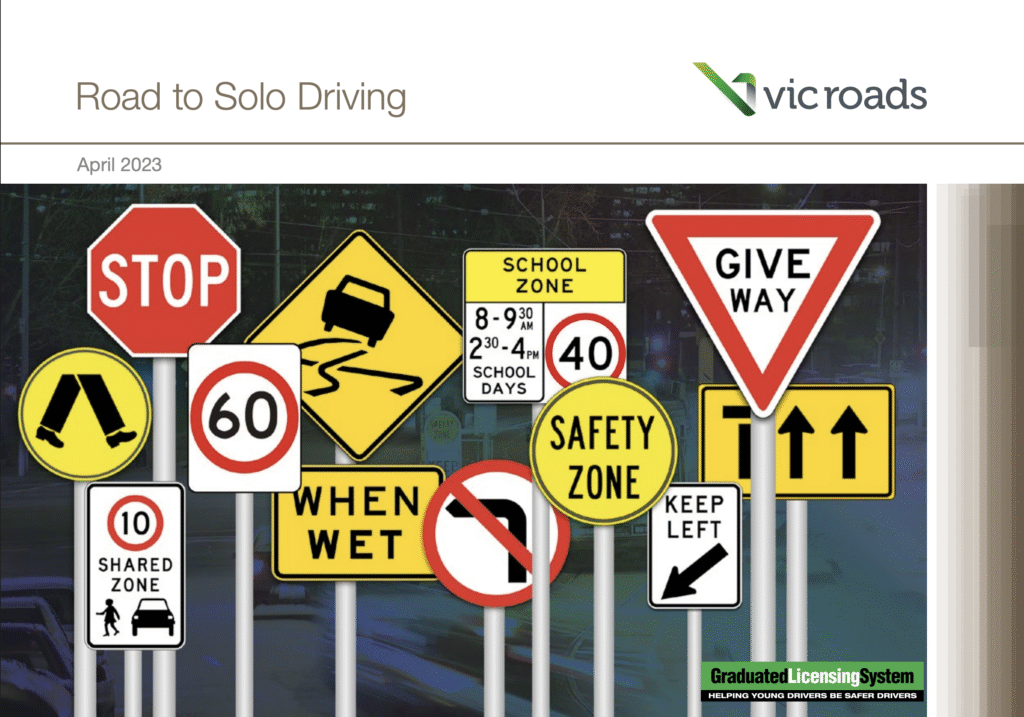
Study guide: Road to Solo Driving handbook (available free at vicroads.vic.gov.au)
⚡ The Connection Nobody Tells You About
"Every road rule topic in the DKT appears again — directly — in the VicRoads drive test criteria. Signalling rules, give way rules, speed limits, roundabout behaviour, stopping at crossings, lane positioning — all of it is formally assessed by the examiner when you sit your practical test 12+ months later. The students who treated the DKT as a speed bump to skip over arrived at the drive test without the foundational knowledge they needed. The students who genuinely understood it arrived with a head start."
— Chamitha Lokuwithana, Ex-VicRoads Licence Testing Officer · Founder, Lessons2Drive
DKT Topics That Appear Directly in the Drive Test Criteria
The VicRoads drive test assesses ten specific Task Assessment Items — each one grounded in road rules you first encounter in the DKT. Here is exactly how they connect, so you study with purpose, not just to pass a test.
Signalling Rules
DKT: When to signal
Drive Test: Signalling Assessment Item
The DKT covers when signals are required and for how long. In the drive test, the Signalling assessment item requires your indicator to be activated for at least 3 seconds before turning, changing lanes, or diverging, and at least 5 seconds before pulling from a parked or stationary position — even when no other traffic is present. Omitting a signal entirely is a Critical Error. Getting the timing wrong still costs marks.
Study focus: Roundabout signalling rules are specifically tested in both the DKT and drive test — left signal for first exit (if less than halfway), no signal for halfway exit, right signal for exits more than halfway around. This trips up students in both tests.
Give Way Rules
DKT: Priority rules at intersections
Drive Test: Gap Selection + Fail to Give Way
Give way rules are among the most heavily tested topics in the DKT — and with good reason. In the drive test, failing to give way when another road user takes evasive action is an Immediate Termination Error that ends the test on the spot. The Gap Selection assessment item also requires you to take the first available safe gap — waiting too long through safe gaps is penalised, not just taking an unsafe one.
Critical connection: The criteria define a specific fail path — if you don't look for conflicting traffic before proceeding at a give way situation AND another driver takes evasive action, the test ends immediately. Understanding give way rules deeply in the DKT builds the instinct you need at the wheel.
Speed Limits and Speed Zones
DKT: Speed limit rules
Drive Test: Speed Choice + Excessive Speed
The DKT covers default speed limits, school zones, shared zones, and how to read speed limit signs. In the drive test, exceeding the speed limit by 5 km/h or more at any time ends the test immediately. In a school zone during operating hours, any excess at all ends the test. Driving 10 km/h or more below the limit for a substantial part of the stage is a Critical Error. Speed in both directions is penalised.
Study focus: The criteria distinguish between regulatory speed limit signs (white rectangle with black numbers — legally binding) and advisory speed signs (yellow diamond — not legally binding). Understanding this distinction in the DKT helps you apply it correctly on the road.
Pedestrian Crossings and Crosswalks
DKT: Types of crossings and rules
Drive Test: Block Pedestrian Crosswalk + Stop at Dangerous Position
The DKT teaches the three types of pedestrian crossings: children's crossings (red and white striped posts, stop lines), marked foot crossings (pedestrian traffic lights), and pedestrian crossings (parallel white stripes). The drive test criteria use all three. Stopping on a crosswalk is a Critical Error. If a pedestrian takes evasive action because you've blocked it, the test ends immediately as a Stop at Dangerous Position error.
Study focus: The criteria also specify that you must not stop unnecessarily before a pedestrian or children's crossing when no pedestrian is present — that's a Too Slow Critical Error. Understanding crossing rules in both directions (what you must do and what you must not do) is essential.
Stop Signs and Give Way Signs
DKT: Sign meanings and required actions
Drive Test: Incomplete Stop + Fail to Stop
The DKT tests the difference between Stop signs and Give Way signs and what each requires. In the drive test, failing to bring the vehicle to a complete stop (wheels fully motionless) behind the stop line at a Stop sign is a Critical Error (Incomplete Stop). Driving past a Stop sign without clearly showing an intention to stop is an Immediate Termination Error (Fail to Stop) — regardless of whether any other traffic is present.
The detail most students miss: The criteria specify the stop must be behind, but within 2 metres of, the stop line. Stopping too far back is also an error. Stopping with the front of the car projecting over the stop line (but not into the crosswalk) is an Incomplete Stop — a Critical Error. These distinctions come directly from understanding what a Stop sign actually requires.
Lane Rules and Road Positioning
DKT: Lane markings and positioning
Drive Test: Lateral Position Assessment Item
The DKT covers lane markings, which lanes to use, and what different line types mean. In the drive test, the Lateral Position assessment item is assessed both for specific tasks and as a stage-wide item across the entire test. Key requirements include: maintaining 1.2 metres clearance from parked vehicles, keeping left of the centre line when turning right, not driving in bicycle-only lanes except in permitted circumstances, and not travelling in the left lane if parked vehicles intermittently block it when another lane is available.
Study focus: Driving on the wrong side of the road approaching an intersection is an Immediate Termination Error (Other Dangerous Action). Understanding centre line rules in the DKT builds the instinct to stay correctly positioned — something that must be automatic under the pressure of a test.
Following Distance and Safe Gaps
DKT: Safe following distances
Drive Test: Following Distance Assessment Item
The DKT introduces the 2-second rule for safe following distance. The drive test criteria formalise this: at least a 2-second gap in good conditions, increasing to at least 3 seconds on wet or unsealed roads. After a lane change, you must resume the correct following distance as soon as practicable. This is assessed during straight drives — the examiner picks a fixed point and watches whether your gap is sufficient.
Study focus: The DKT also covers stopping distances in different conditions. Understanding why the gap increases in wet conditions — reduced grip, longer braking distance — helps you apply it instinctively rather than mechanically counting seconds.
How to Study for the DKT — The Right Way
1
Read the Road to Solo Driving Handbook — don't skim it
Every question in the test is grounded in this handbook. It's available free at vicroads.vic.gov.au. Read it cover to cover at least once, then go back to the sections you're less confident about. Understanding the rules — not just memorising answers — is what stays with you at the wheel 12 months later.
2
Use official VicRoads practice tests until you're consistently passing
The official practice tests use the same format and question pool as the real test. Don't sit the real test until you're passing the practice tests comfortably and consistently — not just once, but multiple times. One lucky pass in practice is not readiness.
3
Track which topics you get wrong — then go back to the handbook for those sections
Don't just note that you got a question wrong — understand why the correct answer is correct. If you're getting roundabout questions wrong consistently, go back to the roundabout section of the handbook and work through it until the rule makes sense. Random memorisation of answers breaks down under different question phrasings.
4
Pay special attention to these high-frequency topics
Based on what the drive test criteria assess most heavily, these DKT topics deserve extra focus: roundabout signalling and give way rules, give way at intersections (T-intersections, cross-intersections, and turns), school zone and speed limit rules, pedestrian crossing types and obligations, lane rules including bicycle lanes, and stopping rules at Stop signs.
5
Read each question fully before answering — don't rush
Many DKT questions are designed to test careful reading, not just knowledge. Two options may appear very similar with one subtle difference that changes the answer. Read the full question, read all options, then answer. You have time — use it.
After the DKT — What Happens Next
Passing the DKT/LPT means you can apply for your learner permit at a VicRoads Customer Service Centre. Once you have your permit, the clock starts — you need to hold it for at least 12 months (if under 21) and accumulate 120 hours of supervised driving, including 20 at night, before you can sit the practical drive test.
The practical drive test is where everything you learned in the DKT gets applied in real traffic — observed by a VicRoads Licence Testing Officer who records a Yes, No, or N/A for every assessment item at every task. The road rules you understood in the DKT become the habits the examiner watches for at the wheel.
Just passed your DKT? Book your first driving lesson.
The habits you build in your first few lessons will define how you drive for life — and whether you pass the drive test 12 months from now. Start with an instructor who knows exactly what VicRoads assesses, because they used to be the one doing the assessing.
Why Your First Lesson Matters More Than You Think
"The first professional driving lesson is the most important one. It's when habits form. If a student learns the correct mirror-signal-head check sequence in their first lesson, it becomes automatic by the tenth. If they learn an incorrect sequence — or no sequence at all — it takes twice as long to fix it later. The DKT gives you the rules. The first lesson shows you how to apply them at the wheel. What happens in that first lesson sets the trajectory for everything that follows."
— Chamitha Lokuwithana, Ex-VicRoads Licence Testing Officer · Founder, Lessons2Drive
✓
We teach to VicRoads criteria from lesson one
Every habit we build — mirror sequence, signal timing, head checks, lateral positioning — is grounded in the official assessment criteria. You're not learning to drive generally. You're learning to drive the way VicRoads assesses.
✓
All instructors hold Working With Children Check
Every Lessons2Drive instructor holds a current Working With Children Check (Victoria). Non-negotiable for us, and it should be non-negotiable for any family choosing an instructor for their teenager.
✓
Lessons start from your home, school, or work
Lessons start from your chosen location within our service areas — Werribee, Point Cook, Hoppers Crossing, Deer Park, Melton, Bundoora, Sunbury, Coolaroo and surrounds. Lesson time begins when we arrive.
Lesson Pricing
$110
90-minute lesson
MOST POPULAR
The DKT is step one. Let's make sure every step after it counts.
Book Your First Lesson with Lessons2Drive
Whether you've just passed your DKT or you're ready to start preparing for your drive test — Lessons2Drive is the only driving school in Melbourne's west founded by an ex-VicRoads Licence Testing Officer. 304 five-star Google reviews. 5.0 star rating.
📞 0400 008 706
✉ Info@Lessons2Drive.com.au
🌐 lessons2drive.com.au