Written by
Chamitha Lokuwithana — Ex-VicRoads Licence Testing Officer
1,800+ official drive tests conducted · Founder, Lessons2Drive
The Hazard Perception Test sits between your learner permit and your drive test — and most students treat it as a box to tick. That's a mistake. After conducting over 1,800 official VicRoads drive tests, I can tell you that the hazard awareness the HPT develops is the exact same awareness the drive test criteria assess when a Licence Testing Officer decides whether to end your test immediately. The HPT isn't separate from the drive test. It's preparation for the most critical moments in it.
What Is the HPT — The Basics
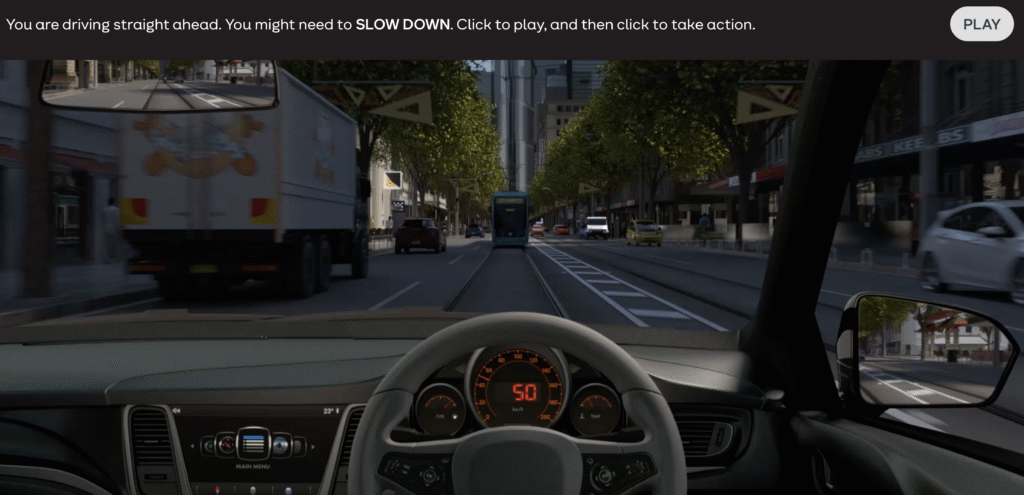
The Hazard Perception Test is a computer-based video assessment available at VicRoads Customer Service Centres. You watch short clips of real driving situations and respond when you identify a developing hazard — a situation that is beginning to require you to take action such as slowing down, stopping, or changing direction. You must pass it before VicRoads will allow you to book the practical drive test.
Format: Video clips of real road scenarios — respond when a developing hazard appears
Location: VicRoads Customer Service Centre — computer-based, in person
When: After completing 120 hours and LPT — before booking the drive test
Preparation: Official VicRoads HPT practice tests available at vicroads.vic.gov.au
⚡ The Connection That Changes How You Should Approach the HPT
"In the drive test criteria, some of the most serious errors — the ones that end the test immediately — are triggered by a failure to perceive and respond to hazards correctly. Fail to Give Way happens when you don't identify a conflict in time. Other Dangerous Action happens when you create a situation that forces another road user to take evasive action. Stop at Dangerous Position happens when you misjudge where to stop relative to other road users. Every one of these is a hazard perception failure at the wheel. The HPT teaches you to see hazards developing early — that skill is what prevents these termination errors when you're being assessed."
— Chamitha Lokuwithana, Ex-VicRoads Licence Testing Officer · Founder, Lessons2Drive
How Hazard Perception Appears in the Drive Test Criteria
The VicRoads drive test criteria define an Immediate Termination Error as any action that causes another road user to take evasive action, causes immediate danger, would cause immediate danger if the examiner didn't intervene, or unnecessarily increases the risk of a collision. Every one of these is rooted in hazard perception — seeing what's developing and responding before it becomes dangerous. Here are the specific criteria items where hazard awareness is directly assessed.
Observation — Continuous Lookout and Mirror Awareness
Task Assessment ItemThe Observation assessment item requires maintaining a continuous lookout ahead, checking mirrors frequently enough to maintain awareness of surrounding traffic, looking for conflicting traffic before proceeding at give way situations, checking mirrors immediately before braking, and looking in the direction of travel before turning. Every one of these is a hazard perception behaviour — constantly scanning for what is developing around the vehicle, not just what is directly in front of it.
HPT connection: The HPT trains you to scan the full frame of the road scenario — not just the centre. This is exactly what the Observation criteria require. A student who passes the HPT by developing genuine scanning habits arrives at the drive test with that skill already embedded.
Gap Selection — Identifying Safe Gaps Before They Close
Task Assessment ItemGap Selection is formally assessed whenever you turn at intersections, enter roundabouts, merge, or change lanes. The criteria require selecting the first available safe gap after an initial observation period. Selecting an unsafe gap — one where another road user takes evasive action — is an Immediate Termination Error (Fail to Give Way). This is a pure hazard perception task: judging whether a gap is genuinely safe requires correctly reading the speed, distance, and trajectory of approaching traffic.
Drive test consequence: If your gap selection forces another road user to brake, swerve, or accelerate to avoid you, the Licence Testing Officer records an Immediate Termination Error (Fail to Give Way) and the test ends immediately — regardless of how well everything else has gone.
Fail to Look — Not Checking Before Proceeding
🟡 Critical ErrorA Critical Error (Fail to Look) is recorded when you don't check mirrors AND don't do a head check before diverging laterally, or when you fail to look for conflicting traffic before proceeding at a give way situation — even when no conflicting traffic is actually present. The criteria are explicit: you must look in the correct direction even if the road appears clear. Hazard perception means checking whether a hazard exists, not assuming it doesn't.
HPT connection: The HPT specifically tests scenarios where a hazard develops from the periphery — a vehicle appearing from a side street, a pedestrian stepping off the kerb, a cyclist moving into your path. Training yourself to look for hazards in those areas builds the same checking behaviour the criteria require at intersections.
Other Dangerous Action — Creating Situations That Force Others to React
🔴 Immediate TerminationThe Other Dangerous Action Immediate Termination Error covers any driving action that unnecessarily increases the risk of collision — even if no collision occurs. Examples in the criteria include: stopping on a railway level crossing while waiting for traffic to clear (because a train could approach at any moment), overtaking across double barrier lines before a blind curve, and remaining on the wrong side of the road approaching an intersection. Every one of these is a failure to perceive the developing hazard early enough to avoid creating it.
HPT connection: The HPT trains you to identify situations where danger is building — not just where it has arrived. Stopping on a level crossing when the road ahead is blocked is a hazard that begins developing the moment you enter the crossing, not when a train appears. The HPT mindset of "what could happen next?" is exactly what prevents these errors.
Following Distance — Maintaining Space to React
🟢 Task Assessment ItemThe Following Distance assessment item requires at least a 2-second gap in good conditions and 3 seconds in poor conditions (wet or unsealed roads). The reason for this specific gap is hazard perception — you need enough distance to identify a hazard developing in front of you and respond before a collision. Driving too close removes the time between identifying a hazard and the point of impact.
HPT connection: Many HPT scenarios involve the vehicle ahead — brake lights illuminating, a vehicle slowing to turn, traffic bunching. These are following distance hazards. Practising the HPT makes you more alert to these scenarios, which naturally improves your following distance habits in real driving.
What a "Developing Hazard" Actually Means — And What It Doesn't
The most common mistake in the HPT is misunderstanding what a developing hazard is. Not every potential danger on the road is a developing hazard that requires a response. The VicRoads drive test criteria define this distinction clearly through the concept of evasive action — a change of course or speed (swerving, stopping, slowing, accelerating) by another road user to avoid a potential collision. A developing hazard in the HPT is one that is moving toward requiring that kind of response.
✓ A Developing Hazard — Respond
A ball rolls onto the road ahead of a parked car — a child may follow
A vehicle at a side street begins edging forward toward your lane
A pedestrian steps off the kerb onto a crossing you are approaching
White reverse lights appear on a parked car as you approach
The vehicle ahead brake lights illuminate suddenly in traffic
✗ Not Yet a Developing Hazard — Don't Click
A child playing on the footpath well away from the road
A car parked at the kerb with no visible movement or lights
A pedestrian standing on the footpath not near a crossing
A vehicle at an intersection with clear space and no movement
A cyclist riding in the bike lane parallel to your direction of travel
The timing principle: In the HPT you score best by responding at the moment a hazard starts to develop — not when it becomes an emergency. Clicking too early (before any development) or too late (when it's already a crisis) both cost points. This is the same principle the drive test criteria apply — an Immediate Termination Error records the moment your action creates or fails to prevent immediate danger, not the moment before or after.
How to Prepare for the HPT — What Actually Works
1
Use the official VicRoads HPT practice tests first
The official VicRoads practice tests at vicroads.vic.gov.au use the same video scenarios and format as the real test. Start here. The format is specific — clicking mechanics, response windows, scoring — and familiarity with the format removes one layer of anxiety from the real test. Don't skip the official materials in favour of third-party practice only.
2
Scan the full scene — not just the road directly ahead
Most hazards develop from the sides — side streets, footpaths, driveways, adjacent lanes. Train yourself to scan the full width of the video frame rather than fixating on the vehicle ahead or the centre of the road. This is the same broad scanning the Observation criteria require throughout the drive test.
3
Think "what could happen next?" — not "what is happening now?"
Hazard perception is about anticipation, not reaction. When you see a ball roll onto the road, the hazard is not the ball — it's the child who may follow. When you see reverse lights on a parked car, the hazard is the vehicle that may emerge into your path. Train yourself to project forward one step in every scenario you see.
4
Don't click at everything — some scenarios have no developing hazard
Some HPT video clips genuinely do not contain a developing hazard that requires action. Clicking randomly or clicking at every car and pedestrian you see will cost you points. If you reach the end of a scenario without identifying a hazard that requires a response — don't click. Let it finish. Restraint is part of the skill being tested.
5
Apply it in real driving during your supervised hours
The most effective HPT preparation is real driving with a deliberate focus on hazard identification. During supervised practice sessions, narrate what you're seeing — "that car is edging forward, I'm covering the brake," "those kids are near the kerb, I'm moving right." This active commentary builds the same scanning habit the HPT and drive test both require, and it makes your 120 hours far more valuable than passive seat time.
6
Don't underestimate it because you've been driving for a while
Experienced learners with close to 120 hours sometimes assume their driving experience is enough preparation. It isn't. The HPT tests a specific skill — identifying the moment a hazard starts developing in a video format with a specific clicking mechanic. General driving experience builds hazard awareness but doesn't prepare you for the test format. Use the practice tests regardless of how confident you feel.
What I Saw in the Drive Test That the HPT Prevents
"The most common Immediate Termination Errors I recorded were not from reckless students — they were from students who simply didn't see things developing in time. They didn't look in the right direction before entering the intersection. They didn't notice the gap was closing before they committed to the turn. They didn't see the pedestrian stepping off the kerb. Every single one of those is a hazard perception failure. The HPT exists because VicRoads knows that if you can identify hazards on a screen, you're building the skill to identify them at the wheel."
— Chamitha Lokuwithana, Ex-VicRoads Licence Testing Officer · Founder, Lessons2Drive
After the HPT — What Comes Next
Once you've passed the HPT, you can book your practical drive test through myVicRoads. This is the final step — and the one where everything you've learned, including the hazard awareness the HPT developed, gets applied in real traffic with an examiner recording every assessment item.
Before booking, we strongly recommend a mock test lesson using the actual VicRoads marking criteria. The drive test has two stages — Stage 1 on lower-traffic roads for 10 minutes, Stage 2 on arterial roads at 60–80 km/h for 20 minutes. Knowing how the test is structured, what tasks are assessed at each stage, and where the Immediate Termination Error triggers are gives you an enormous advantage that most students arrive without.
Just passed your HPT? Book your pre-test lesson.
A mock test lesson using real VicRoads criteria before you book your drive test is the single most effective thing you can do. You'll know exactly where you stand — and what to fix — before your result counts.
Train with someone who knows what comes after the HPT
Lessons2Drive — Founded by an Ex-VicRoads Licence Testing Officer
Chamitha conducted over 1,800 official drive tests and trained new Licence Testing Officers within VicRoads. Every lesson at Lessons2Drive is built around the exact criteria your examiner will apply. 304 five-star Google reviews. 5.0 star rating. Serving Werribee, Point Cook, Hoppers Crossing, Deer Park, Melton, Bundoora, Sunbury, Coolaroo and surrounds.
📞 0400 008 706
✉ Info@Lessons2Drive.com.au
🌐 lessons2drive.com.au