Written by
Chamitha Lokuwithana — Ex-VicRoads Licence Testing Officer
1,800+ official drive tests conducted · Founder, Lessons2Drive
Melbourne's west gets real winter. Cold mornings, heavy rain on the Western Ring Road, wet intersections on Ballarat Road, foggy conditions through Melton. For learner drivers accumulating their 120 hours, winter is not an obstacle — it's some of the most valuable experience you can build. The VicRoads drive test criteria explicitly account for adverse conditions. Understanding what changes and what doesn't in wet and cold weather is what separates a confident driver from a nervous one.
⚡ What the VicRoads Drive Test Criteria Actually Say About Adverse Conditions
The criteria are specific about this. Three assessment items change in poor conditions — and knowing the exact thresholds protects you both on the road and on test day.
Following Distance — increases from 2 seconds to 3 seconds minimum
On wet or unsealed roads, the criteria require at least a 3-second gap behind the vehicle ahead — not the standard 2-second gap. This accounts for the longer braking distances on reduced-grip surfaces. The examiner assesses this during straight drives in Stage 2.
Speed Choice — driving below the limit is accepted when conditions justify it
Normally, driving 10 km/h or more below the speed limit for a substantial part of the stage is a Critical Error (Too Slow). The criteria specifically exempt this when road or traffic conditions — including wet or unsealed roads, or congested slow traffic — make it unsafe to drive closer to the limit. The condition must genuinely justify the speed, not nervousness.
Control — smooth acceleration and braking are assessed throughout both stages
The Control stage assessment item requires smooth acceleration and deceleration throughout. In wet conditions, harsh inputs cause loss of traction. The criteria that require smooth control in normal conditions are even more important in winter — what's just penalised in dry conditions can cause a genuine hazard in the wet.
Wet Weather Driving — Melbourne's West in Winter
Most of your winter driving in Melbourne's west will be in rain — not snow. Heavy rain on arterial roads, slippery intersections after the first rain in weeks, reduced visibility, and longer braking distances are the real conditions you need to be prepared for.
1
Increase Your Following Distance to at Least 3 Seconds — Every Time It's Wet
On a wet road, your tyres have significantly less grip than on dry bitumen. The distance your car travels between deciding to brake and actually stopping increases — sometimes dramatically. The VicRoads criteria require at least 3 seconds of following distance in poor conditions. In heavy rain or on roads where water is pooling, consider increasing this further.
How to measure it: Pick a fixed point on the road ahead — a line marking, a sign shadow, a manhole cover. When the car in front passes it, count "one thousand and one, one thousand and two, one thousand and three." If your car reaches that point before you finish counting, you're too close. Move back. Do this on every wet drive until it becomes automatic.
2
Smooth Inputs Only — Accelerate Gently, Brake Progressively
On wet roads, harsh inputs to the brakes, accelerator, or steering wheel reduce traction or shift weight abruptly — both of which can cause the car to slide. The same smooth control the VicRoads criteria assess is exactly what wet roads demand. Accelerate gently when pulling away. Brake progressively — apply pressure gradually rather than stabbing the pedal. Steer smoothly through curves rather than turning sharply.
For learner drivers: Winter is actually excellent practice for smooth control habits — the feedback from the car is more immediate. A slightly jerky brake application that goes unnoticed on dry roads produces a small lurch on wet ones. Use this feedback to refine your inputs rather than avoid the conditions.
3
Headlights On Low Beam — In Rain, Even During the Day
In heavy rain or reduced visibility, turn on your headlights — low beam. This is not just about seeing the road. It's about being seen by other drivers, cyclists, and pedestrians whose visibility is also reduced. The VicRoads drive test actually requires low beam headlights to be on throughout both stages — a rule that exists for exactly this reason. Do not use high beams in rain or fog — the light reflects off water droplets and reduces your visibility rather than improving it.
Victorian road rule: You must use headlights when driving in conditions that reduce your ability to see clearly at 100 metres ahead, and when you cannot clearly see a person or vehicle at 100 metres. In heavy rain, this threshold is often reached.
4
The First Rain After a Dry Spell Is the Most Dangerous
When rain falls after a long dry period, it mixes with accumulated oil, rubber, and dust on the road surface — creating an extremely slippery layer before the rain washes it away. This initial period can be significantly more dangerous than established rain. In Melbourne's west, the first significant rain after a dry summer or autumn spell warrants extra caution, particularly on arterial roads and at intersections where oil deposits accumulate.
What to do: Increase following distance further, reduce speed below what you'd normally use for wet conditions, and be especially smooth through intersections. This phase typically passes after 10–20 minutes of rain as the road surface is washed clean.
5
Aquaplaning — What It Is and What to Do
Aquaplaning (also called hydroplaning) occurs when a layer of water builds up between your tyres and the road surface faster than the tyre can displace it. The result is the tyre losing contact with the road — the car effectively floats on the water and steering and braking become ineffective. It typically happens at higher speeds in heavy rain or through large puddles.
If your car aquaplanes:
→Stay calm — do not brake suddenly or steer sharply
→Ease off the accelerator gently — let the car slow naturally
→Hold the steering wheel firmly but don't overcorrect
→Wait for the tyres to regain contact with the road before braking
Prevention: Maintain correct tyre pressure and tread depth. Reduce speed in heavy rain. Avoid large puddles where possible. Tyres with worn tread cannot displace water effectively — aquaplaning risk increases significantly as tread depth decreases.
6
Never Drive Through Floodwater
This rule is absolute and non-negotiable. Floodwater conceals road damage, open drains, and debris. Moving water exerts enormous force — just 15 centimetres of fast-moving water can push a car off course, and 30 centimetres can float most vehicles. The depth of water is impossible to judge visually. If you can't see the road surface clearly through the water, do not drive through it.
Turn around, don't drown. This applies to suburban streets as much as country roads. After heavy rain in Melbourne's west, low-lying areas and underpasses can flood rapidly. If roads are closed or water is across the road, turn around and find an alternate route. No journey is worth the risk.
7
Vehicle Preparation — What to Check Before Winter Sessions
The VicRoads pre-drive safety check at the start of every drive test requires the applicant to confirm that headlights, brake lights, windscreen washers and wipers, turn indicators, horn, and hazard lights all operate correctly. This isn't just a test requirement — these systems are what keep you visible and in control in winter conditions. Check them before every session, not just on test day.
Tyres
Check tread depth — minimum 1.5mm legally but 3mm+ recommended for wet conditions. Check pressure when cold.
Wipers and demisters
Wipers that smear rather than clear significantly reduce visibility in rain. The VicRoads criteria require windscreen washer and wipers to be operational — test both before the session.
Lights
Headlights (high and low beam), brake lights, and indicators must all be working. Cold weather can accelerate globe failure — check regularly through winter.
Brakes
If brakes feel spongy, pull to one side, or make unusual noise — get them checked before driving in wet conditions where stopping distances are already extended.
⚡ Why Winter Driving Sessions Are Worth More Than Summer Ones
"From the examiner's seat, I could immediately tell which students had driven in varied conditions and which had only practiced in good weather. The ones who'd driven in rain had naturally better following distance habits, smoother brake applications, and more consistent observation — because wet conditions demand it and penalise you when you get it wrong. The criteria allow for reduced speeds in poor conditions, but they don't allow for poor habits. Winter practice builds the right ones faster than any amount of dry-weather driving."
— Chamitha Lokuwithana, Ex-VicRoads Licence Testing Officer · Founder, Lessons2Drive
Cold Mornings in Melbourne's West — Frost, Fog, and Reduced Visibility
❄
Frost on the windscreen — clear it completely before moving
A partially cleared windscreen is one of the most dangerous ways to start a morning drive. Use your demister (both front and rear) and allow time for full visibility before moving. Pouring hot water on a frozen windscreen can crack the glass. Use a proper ice scraper or allow the demister to do the work. The VicRoads pre-drive check requires the demister to be identified — because visibility in winter genuinely depends on it.
🌫
Fog — slow down, increase distance, use low beam not high beam
In fog, high beams reflect off the water droplets and reduce visibility. Use low beam headlights. If your vehicle has front and rear fog lights, use them in heavy fog. Reduce speed to a level at which you can stop within the distance you can see clearly. In Melbourne's west, fog is most common in low-lying areas around Werribee and Melton — particularly in autumn and early winter mornings.
🌡
Black ice — invisible and extremely dangerous on bridge surfaces and shaded sections
Black ice forms when surface moisture freezes on road surfaces that cool rapidly — bridges, overpasses, shaded sections under trees, and areas near waterways. It appears wet or slightly shiny but provides almost no traction. If you encounter it: don't brake, don't steer sharply, ease off the accelerator gently, and hold the wheel steady. In Melbourne's west, black ice risk is most significant on rural roads in the Bacchus Marsh and Melton areas on clear, cold winter nights and mornings.
For Learner Drivers — Make Winter Count Toward Your 120 Hours
The VicRoads GLS encourages learners to practise in a range of different conditions and in a staged progression. The criteria manual specifically notes that gaining this experience helps learners acquire safer driving habits and increases their chance of passing the drive test. Winter conditions are not something to wait through — they're something to drive through, deliberately and with supervision.
✓ At least 10–15 of your supervised hours should include wet road conditions
✓ Practice the 3-second following distance deliberately on every wet drive
✓ Use winter sessions to refine smooth brake application — the feedback is immediate
✓ Cold mornings are excellent opportunities for your mandatory 20 night hours
✓ Never cancel a supervised session just because it's raining — those hours are the most valuable ones
Planning a Trip to the Snow? Alpine Driving Essentials
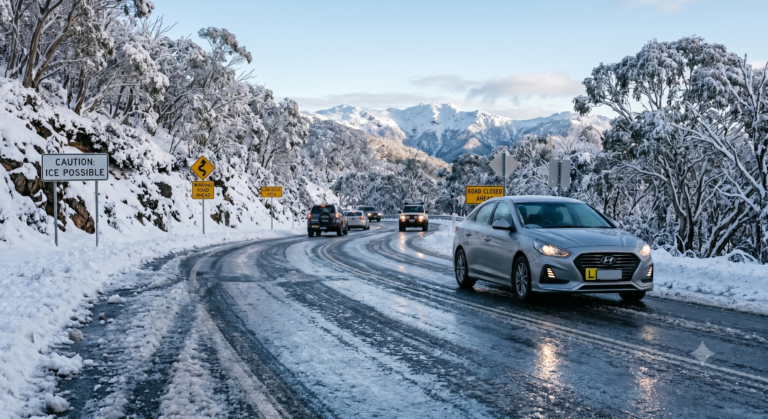
If you're driving to Victoria's alpine areas — Mount Buller, Falls Creek, Mount Hotham — conditions are significantly more demanding than Melbourne winters. Here are the essentials.
→Check road conditions before leaving — visit VicTraffic at victraffic.vic.gov.au for current alpine road conditions and chain fitting requirements
→Snow chains are legally required when directed by road signs in designated alpine areas — know how to fit them before you need to, not while standing in the snow
→Use low gears on descents — engine braking on steep downhill sections reduces reliance on your brakes and prevents overheating
→Never brake in a corner on snow or ice — apply any necessary braking before the corner while still travelling straight
→Note for learner drivers: Alpine driving is beyond the scope of standard learner permit practice — do not include alpine trips in your first 120 hours without significant prior wet-weather experience on suburban and arterial roads
Don't let winter slow your progress
Book a Winter Driving Lesson with Lessons2Drive
Our instructors teach on Melbourne's real roads — including the arterial roads, intersections, and conditions your learner will face. We teach the criteria-based habits that make winter driving safer, not just more manageable. Serving Werribee, Point Cook, Deer Park, Melton, Sunbury, Bundoora, Coolaroo and surrounds.
📞 0400 008 706
✉ Info@Lessons2Drive.com.au
🌐 lessons2drive.com.au